
'/%3E%3C/svg%3E)


'/%3E%3Cpath%20fill='%23b2b2b2'%20d='M241%20382q0%2016%2017%2026%2017%2011%2042%2011t42-11q16-11%2017-26V269H241'/%3E%3Cpath%20fill='%239f7e00'%20d='M241%20379q0%2014%208%2023%209%209%2021%209%2014%200%2021-9%209-9%209-23V269h-59'/%3E%3Cpath%20d='M241%20339v-70h59v110q0%2014-9%2023l-6%205v-68h-15v72q-8%200-14-4v-68zm59%2040c0%2022%2015%2032%2029%2032%2021%200%2030-18%2030-32v-40h-59'/%3E%3Cpath%20fill='%239f7e00'%20d='M266%20277v5h2v12h-3v-5h2v-5h-9v5h2v5h-4v9h3v18h-5v10h34v-10h-5v-18h3v-9h-4v-5h2v-5h-9v5h2v5h-3v-12h2v-5zm42%20101q0%2010%206%2017%206%206%2015%207%2010-1%2016-7%206-7%206-17v-29h-43'/%3E%3Ccircle%20fill='%230044ad'%20cx='329.5'%20cy='372'%20r='6'/%3E%3Cellipse%20fill='%230044ad'%20cx='300'%20cy='340'%20rx='16'%20ry='21'/%3E%3C/svg%3E)


Custom Safety and Isolation Transformers Tailored to Your Needs
We manufacture safety and isolation transformers both in standard versions and fully customized models, designed to order according to the primary and secondary voltage values requested by each customer.
Over time, O.C.E. has introduced advanced technical solutions to ensure increasingly higher quality and maximize customer satisfaction.
Each transformer can be configured with various construction options to perfectly meet the needs of installers, designers, and system integrators.
Custom Design – Total Flexibility for Every Requirement
Thanks to a thorough analysis of our clients’ needs, we have developed an advanced customization method that allows us to reduce delivery times for personalized safety and isolation transformers.
What we can build for you:
-
Multi-secondary outputs up to 5
We manufacture transformers with up to five secondary outputs, each with different voltages and powers, optimizing space and cost. -
Custom voltages
We configure input and output voltages according to customer specifications, ensuring adaptability to various applications. -
Various types of terminals
We offer a selection of terminals to meet the specific needs of each project. -
Custom terminal arrangement
We adapt the layout of input and output terminals based on customer requests, facilitating installation. -
Flexible delivery times
We manage production schedules to align with your project deadlines. -
Collaboration on new projects
We are available to work together on innovative projects, providing tailor-made solutions. -
ROHS compliance
Our products comply with the ROHS directive, ensuring environmental conformity.
Isolation Transformers – Reliable Safety
The transformer’s two windings are separated by a multi-layer galvanic insulation system in Class F, designed to minimize contact between live parts and ground. In the event of primary insulation failure, this system limits the possibility of dangerous voltages.
Our isolation transformers ensure a secure separation between primary and secondary windings, thanks to the multi-layer insulation that enhances protection and reduces the risk of hazardous voltages.
This protection is essential to:
-
Limit leakage currents to ground
-
Prevent dangerous electrical discharges
-
Protect personnel and equipment
Ideal for electrical panels, automation systems, and industrial environments, the transformers are available in standard or customized versions, with voltage ratings adjustable to meet specific customer requirements.
Safety Transformers – Low Voltage Protection
Safety transformers are a type of isolation transformer designed to supply low voltage safety circuits (SELV), with a secondary voltage below 50 V.
They are used to protect people and equipment in applications where maximum electrical safety is required.
Available in standard or customized versions according to customer needs.
Choice of terminal block arrangement
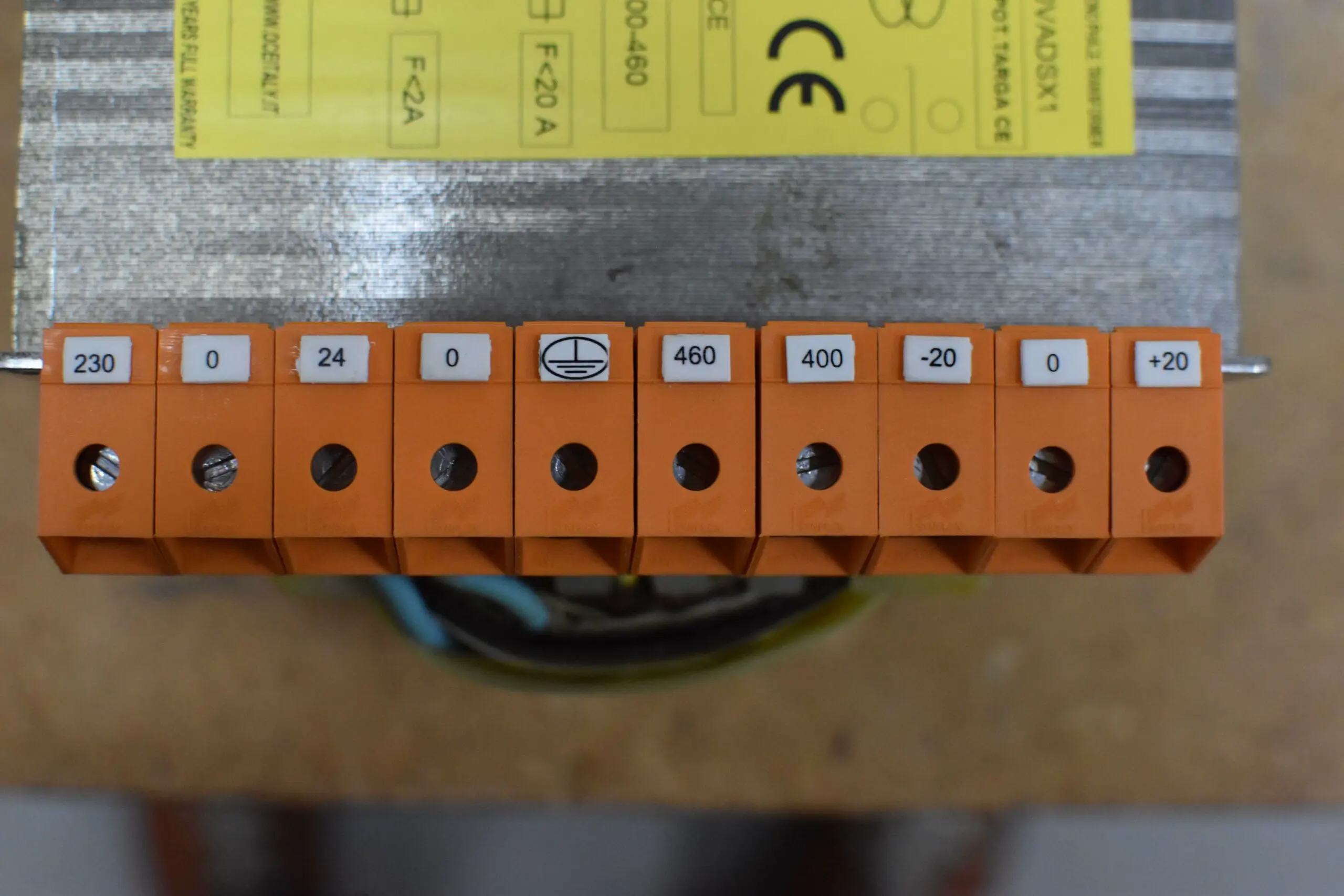
You can choose your own terminal arrangement
Electro-medical equipment (safety and isolation)
We build transformers compliant with the electromedical standard CEI EN60601-1.
Further Information
The thermal insulation class indicates the ability of the enamel coating on the copper conductors to withstand the temperature rise generated during transformer operation.
In practical terms, it defines the maximum operating temperature the insulation can tolerate without degrading, thereby ensuring the product’s safety and long-term durability.
All our transformers are built using Class F materials (155°C), providing high thermal resistance and reliable performance even under demanding operating conditions.
The electrostatic screen is a thin copper foil placed between the primary and secondary windings of the transformer. Its height varies depending on the type of bobbin used.
Connected to ground via a yellow/green cable, its purpose is to reduce distortion and electromagnetic interference, ensuring better signal quality and greater safety.
The electrostatic screen is mandatory in transformers intended for the electromedical sector, but all O.C.E. transformers are equipped with it, regardless of the field of use, to ensure high standards of reliability and protection.
There are different types of insulation, but the most common are basic insulation and supplementary insulation.
Basic insulation provides the primary barrier separating live parts from the rest of the system, ensuring protection against accidental contact.
Supplementary insulation is an additional, independent layer designed to act in case the basic insulation fails, thereby enhancing overall safety.
All our transformers feature double insulation between primary and secondary, achieved by increasing the insulating layers, to ensure enhanced safety and long-lasting performance.
A single transformer, more windings, more space at low cost
As plant design becomes increasingly complex, space and cost constraints are growing challenges for designers.
With our multi-output transformers, O.C.E. helps customers address space limitations. A single product can power loads with different voltages and power ratings, offering key benefits:
- More available space (one transformer instead of multiple units)
- Lower purchase costs
Fields of Application (General Overview)
In control and command electrical panels, single-phase transformers are used to supply isolated power to low-voltage auxiliary circuits, such as relays, contactors, signal lamps and control devices.
This electrical isolation allows the separation between the power circuit and the control circuit, improving overall safety and reliability of the electrical panel.
Single-phase transformers are commonly installed in industrial and civil systems to supply auxiliary devices that require voltages different from the main power network (including 24 VAC, 110 VAC, 115 VAC and 230 VAC applications), providing the appropriate AC voltage needed for the correct operation of auxiliary and control circuits.
In industrial and civil electrical system revamping projects, single-phase transformers are often retained to supply already-wired low-voltage auxiliary circuits.
In many legacy applications, it is preferable to continue using safety voltages such as 24 VAC, avoiding a full replacement of existing wiring, electrical panels, and installed devices.
Using a single-phase transformer in these contexts allows for:
-
Supplying the necessary power to auxiliary circuits without modifying the existing infrastructure
-
Ensuring electrical isolation between power circuits and control circuits
-
Maintaining compatibility with previously installed devices, such as relays, contactors, and signal towers
Voltage Supply and Adaptation – Marine Auxiliary Circuits
Transformers supply auxiliary circuits such as interior lighting, signal towers, control systems, and other onboard devices.
They also allow conversion of the voltage available from the vessel or shore power to match the requirements of the loads, ensuring compatibility with already installed circuits without invasive modifications to the system.
Electrical Isolation and System Protection
When connecting to external power networks (shore power), transformers provide electrical isolation between the vessel and the dock, reducing the risk of electrical faults, interference, and damage to sensitive equipment.
Transformers can be single-phase or three-phase, depending on the complexity of the system, and are used in both small onboard installations and more complex marine electrical setups.